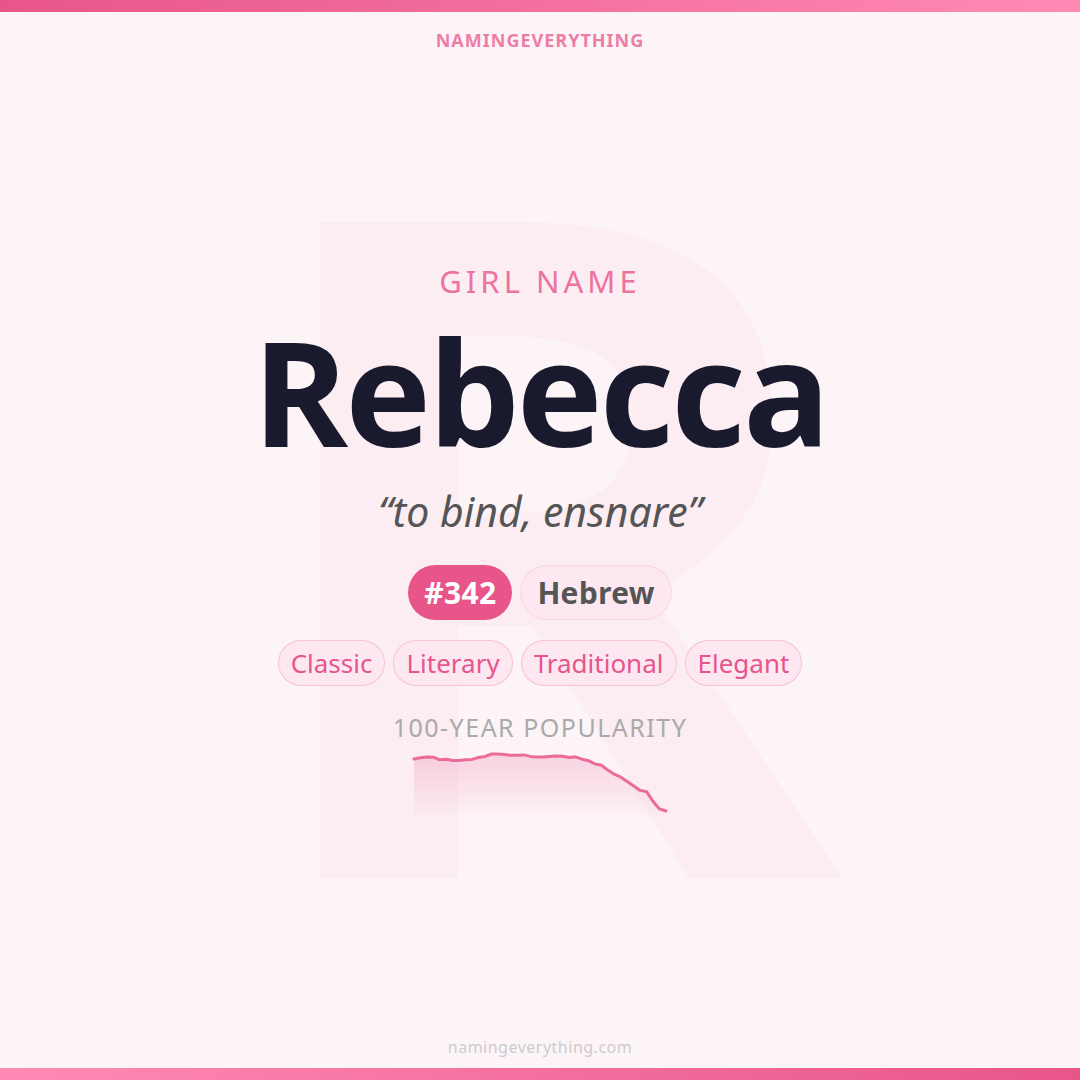
"to bind, ensnare"
Origin: Hebrew
Language: English
Pronunciation: [ r-uhb-EHK-uh ]
Does Rebecca flow with your last name?
A biblical matriarch with timeless literary grace
Reviewed by the NamingEverything Editorial Team · Updated
Similar Names
Names Like Rebecca
Same sound, same style — different options
Nicknames
Nicknames for Rebecca
4 shorthand options for every setting
"to bind, ensnare"
"knotted cord"
Personalized to your state, siblings, and priorities. Free playground safety preview included.
Is Rebecca the #1 name in your state, or barely on the radar?
Enter your other kids' names. We score how well they sound together.
Playground safety check is free. Full report is $9.
What do you want to do with this name?
Add it to your shortlist. Not losing this one.
Put Rebecca head-to-head with your other picks.
Start comparing →See what Rebecca actually gets called.
Browse nicknames →Rebecca derives from the Hebrew name Rivkah (רִבְקָה), whose exact meaning is debated but likely comes from a root meaning 'to bind' or 'to snare,' with some scholars suggesting 'captivating' or 'knotted cord.' In the Book of Genesis, Rebekah was the wife of Isaac and mother of Esau and Jacob, one of the four matriarchs of the Jewish people. Her story — chosen for Isaac through divine guidance — is one of the most detailed portraits of a woman in the Hebrew Bible.
Rebecca was a fixture in the US top 10 from the 1940s through the 1970s, driven by its biblical authority and the appeal of its crisp sound. Daphne du Maurier's gothic novel Rebecca (1938) also kept the name culturally alive. Its popularity has gradually declined since the 1980s as it became perceived as generational.
As one of the four matriarchs of Judaism, Rebekah holds immense significance in Jewish tradition. In Christian tradition, she appears in the New Testament as an example of God's grace (Romans 9:10). The name's long run in English literature — from the Bible through du Maurier's Rebecca and beyond — gives it deep cultural roots.
Rebecca first appeared in US Social Security records in 1950.
Over 664,839 babies have been named Rebecca in the United States since SSA records began.
Today, Rebecca is past its peak , currently ranked #342 for girl names in the US .
Year-by-year popularity data will be available soon.
Musician
1997
American singer who became a viral internet sensation with the song 'Friday' in 2011
Actor
1983
Swedish actress known for Mission: Impossible, Doctor Sleep, and Dune
Other
The mysterious, beautiful first wife of Maxim de Winter in Daphne du Maurier's 1938 gothic novel Rebecca
"ivory white"
"oak tree clearing"
"Gael, wanderer"
"pure"
Compare Rebecca with:
Suggested pairings based on syllable flow and style
Timeless choice, English heritage match, balanced 3-2 syllable flow
Timeless choice, smooth 3-1 syllable flow
Timeless choice, English heritage match, balanced 3-2 syllable flow
Timeless choice, smooth 3-1 syllable flow
Classic pairing, smooth 3-1 syllable flow
Timeless choice, smooth 3-1 syllable flow
Timeless choice, English heritage match, balanced 3-2 syllable flow
Timeless choice, smooth 3-1 syllable flow
Timeless choice, smooth 3-1 syllable flow
Timeless choice, smooth 3-1 syllable flow
Middle Names
Middle Names for Rebecca
6 name pairings with syllable flow tips
Phonetic neighbors that share Rebecca's rhythm, vowel shape, or consonant cluster. Tap any name to see its full "names like" list.
Check how Rebecca fits with existing sibling names — style, sound, and origin.
Enter sibling names above to see compatibility.
Rebecca is also used as a boy name, ranked #14236.
View Rebecca as a boy name →Start a baby registry
Free welcome box on Amazon
The Baby Name Wizard
Names that age well — book
Nursery name sign
Personalized wooden letters
We may earn a commission from these links.
Names that share meaning themes with Rebecca
Start a tournament bracket with Rebecca and other names you're considering.
Start a TournamentCheck how Rebecca sounds with your surname and test for potential nicknames.
Analyze This NameCreate names for D&D and RPG characters
Find the perfect name for your furry friend
Names for fictional characters across genres
Old French origin
"ivory white"
#404 in US
Old English origin
"oak tree clearing"
#519 in US
Medieval Latin origin
"Gael, wanderer"
#201 in US
English origin
#311 in US
Greek origin
"pure"
#175 in US
Middle English origin
"wild rose"
#523 in US
Hebrew origin
"lion, lion of God"
#534 in US
Hebrew origin
"who is like God?"
#409 in US

Download a shareable image with Rebecca's meaning, origin, and popularity. Ready for Instagram, Pinterest, or texting to your partner.
Browse all middle names, sibling names, or similar names.
Rebecca is a girl name with English, Hebrew, Jewish, Christian, and European origins . The name means "to bind, ensnare" in Hebrew .
Is Rebecca a boy or girl name? Rebecca is used as both a girl and boy name. As a girl name, it ranks #342 in popularity. As a boy name, it ranks #14,236. Rebecca is more commonly used as a girl name.
Rebecca is currently ranked #342 in popularity for girl names in the United States.
The name Rebecca has 3 syllables and is pronounced r-uhb-EHK-uh, making it distinctive and memorable.
Common nicknames for Rebecca include Becca, Becky, Beck, and Reba. These shorter forms provide casual alternatives while keeping the elegance of the full name.
Alternative spellings of Rebecca include Rebekah, Rebeca, Rebel . Each spelling variation gives the name a slightly different character while preserving its sound and meaning.
Start a registry
Free welcome box on Amazon
Baby Name Wizard
Names that actually age well
Nursery name sign
Personalized wooden letters
We may earn a commission from these links.
Tinder-style for baby names. Build a shortlist fast, then share it with your partner.